

Thank you for supporting Examined Family, a place where we wrestle with a wide range of urgent questions (How does care shape our days? What do we owe one another? What really matters?) through an intimate and fierce lens. I’m so grateful for your careful reading and consistently wise comments, and for all you do to support this space financially and through word-of-mouth to those that you think could benefit from it. This week I’m diving into the political deep end. I hope you’ll find it adds another layer to your witness this week.
I have been interested in people, particularly White women, who put their bodies on the line for others for a long time. In my book, Do It Anyway: The New Generation of Activists, the very first profile is of Rachel Corrie, the young Washingtonian who was killed while standing in front of an Israeli military bulldozer about to destroy a home in Gaza in 2003.
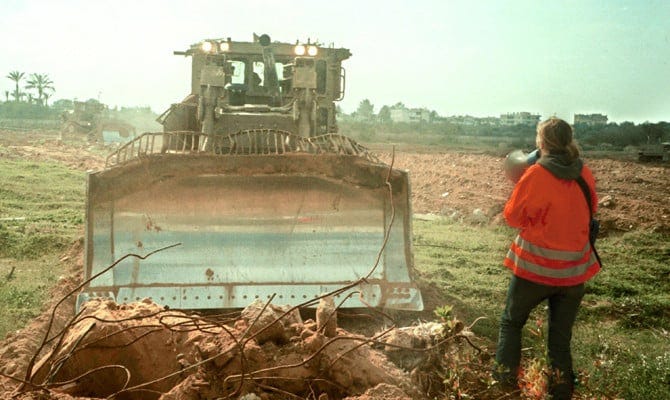
Rachel died at only 23 years old, but she left behind some provocative and poetic language about the very human predicament of being a deeply-feeling person in such a deeply-broken world:
This rant is the result of the sinking realization that the best of what we do is mitigation. I can’t cool boiling waters in Russia. I can’t be Picasso. I can’t be Jesus. I can’t save the planet single-handedly. I can wash dishes.
Thinking it over, I realized that the most powerful action I can take toward societal improvement will have to start close to home, arising not from the need to leave a mark on history, but from empathy and sincere understanding of the place in my life where neglect exists.
The irony, of course, is that she didn’t stay close to home. She didn’t “wash dishes.” She put her body in front of a 100,000-pound vehicle and it would be the last thing she ever did. In my late 20s, as I examined her life and tragic death, her controversial choices, part of me felt envious. Her decision to pick an injustice and dedicate her privileged body to it, her extreme end—it felt congruent with the turmoil of emotions inside of me. Even so, I was careful not to romanticize her death. At the time I wrote:
Living is hard as hell. True. Making daily choices about how to use our lives, how to leave our little corners of the world better than we found them, how to eat and speak and love ethically—its enough to make one jealous of the seeming simplicity of Rachel’s ‘one good thing.’ But we must resist that urge. Rachel is dead, and so are all of her possibilities.
I began thinking about Rachel Corrie again this week as I processed the news of Renee Nicole Good’s murder in Minneapolis. It feels like another moment where a great and ongoing injustice becomes legible to a wider public because of the incomprehensibility of the state-sanctioned murder of a White woman. As Anya Kamenetz wrote:
We have to sit with the fact that her killing resonated more than the 32 total deaths in ICE custody last year, the torture performed on people in El Salvador’s CECOT prison, or the violent deaths of Silverio Villegas González, Roberto Carlos Montoya Valdés, Jaime Alanis, Josué Castro Rivera, and Walter Francisco Cerrato Cabrera during ICE enforcement actions.
This doesn’t, of course, mean that we shouldn’t be paying attention to the brutal murder of mother, wife, friend, poet, and neighbor Renee Nicole Good. Or, for that matter, Heather Heyer, who was mowed down during the protests in Charlottesville in 2017; her own mother said, “A White girl had to die for people to pay attention.”
We should not feel guilty for caring about the murder of anyone. But it does mean that, for some of us, even our most righteous responses are situated within an internalized caste system of whose death shocks and whose death remains largely invisible. I include myself in this us. Until I read Anya’s post, I didn’t actually register that 2025 was the deadliest year in terms of ICE involvement in decades.
I was reminded of a conversation I had with a big-hearted guy named Steve who spent much of 2024 selling Trump merch on the side of the road in Orange County. I interviewed him for this series I did for my Slate podcast.
When I asked Steve if there were any bright moral lines for him, if there was anything he might hear that would make Trump lose his support, he somewhat quietly admitted that separating immigrant kids and their families felt like something he just couldn’t abide by. If that happened, he would be out. “That’s already happening,” I told him.
“Is it?” he asked. “Is it really?”
I’ve thought about this moment may times since. Even our bright moral lines these days are sometimes not legible to us because of our algorithmic echo chambers. And what’s more, when our bright moral lines are crossed, if we are brutally honest with ourselves, we realize that they are often embedded in the same dehumanization that motivated the “murderers.” The ICE agent that shot Renee Nicole Good in the face has been steeped in a racist, xenophobic worldview. So have I. I didn’t know about the murders of Silverio Villegas González, Roberto Carlos Montoya Valdés, Jaime Alanis, Josué Castro Rivera, and Walter Francisco Cerrato Cabrera. I had never even read their names until I read the name Renee Nicole Good.
There is a part of me, as I write these words, that wants to delete the whole post and instead send a dispatch celebrating the creativity, solidarity, and beauty of what is happening all over the country, but especially in Minneapolis without any caveats or complexity. Perhaps you, like me, are hungry for simple stories of American heroes to counter all the simple stories of American monsters that we are bombarded with daily. We’re in the streets! We’re showing up for our neighbors! Isn’t that the point? Yes…and.
We should fight the extreme manifestations of our supremacist culture anywhere and everywhere it flares up—this gorgeous, righteous, multi-racial, intergenerational NO! we’re witnessing in the streets of Minneapolis and beyond—and we should resist the comfort and delusion that we are not also disfigured by it. Many of us don’t see murder until it destroys a body that looks like our own. That is a violent oversight. We can be both galvanized and implicated, rage and reflect, grieve and reckon.
White women’s bodies like mine, in particular, register with some of us, not just because they are familiar, but also because they are layered with symbolic meaning: goodness, purity, beauty, deservingness, domesticity, self-sacrifice. This is not to say, of course, that this country actually honors White women’s bodies with what they need and want, mind you, just that the schemas in which our subconscious categorizes women’s bodies are incongruent with getting shot at point blank range in the face by a man in uniform. So when this footage seeps into our social media feeds, we take notice. The fact that it seeps into our social media feeds at all is the first indication that our algorithms already know we will take notice because a White woman was behind the wheel. The invisible infrastructure of our online lives now knows our subconscious better than we do—a dangerous force along with our guns and our machismo and our militarization.
I am interested in the ways in which White women use these schemas to subvert, disarm, and trick authoritarians and racists. The Wall of Moms. Raging grannies. The cute White women making Insta videos about integrating schools. The suburban book clubs and podcasts that sprinkle in radical re-education alongside the romance novels. And, of course, so many examples from history that aren’t well known enough, like Anne Braden, who helped a Black couple buy a house in an all-white neighborhood of Louisville, Kentucky in 1954 (among so much else).
White women like me have an opportunity in this moment to think creatively about how and where we are showing up. And alongside our creative action, we can continue to strengthen our capacity to hold the enduring truth: that our action doesn’t absolve us from continually unlearning. So how do we know ourselves and our country better—more soberly, more broadly, more texturally? In Outgrowing Modernity, Vanessa Machado de Oliveira writes:
Relational witnessing is not passive observation nor performative gestures. It is the slow, intentional work of staying present with all facets of a crisis: the suffering of those enduring harm, the resilience they embody, and the actions of those who inflict harm as reflections of humanity’s fractured relational fabric. The practice of witnessing refuses to replicate harm by wishing destruction on the destroyer. Instead it asks us to sit with the pain, to let it implicate us, and use that implication as a lever for personal and collective regeneration.
So let us mourn and take to the streets in honor of Renee Nicole Good’s kind and righteous legacy. Let us train with our neighbors on how to resist ICE agents destruction everywhere and anywhere it lands. Let us join protests against Hiltons and host potlucks with our neighbors on Friday. Let us join efforts that welcome immigrants with open, loving arms.
Meanwhile, let us notice our own noticing—how it is available in different ways and for different bodies? And this form of accountability is really hard and sacred: let’s spend as much time wondering about the inner life and material opportunities available to ICE agents as we do lifting Good’s legacy up. How did this violent and repulsive version of our worst nationalistic instincts come to be? What actions could disturb, distract, confuse, even redeem those who have found themselves swept along into it? Who would they rather be?
New ICE agents are being recruited through very particular kinds of messaging—framing the opportunity, not just as a monetary one, but as a chance for an exalted role in restoring America to its former greatness. They are being targeted through the most sophisticated of technological strategies, including geofencing—which means that people physically near gun shows, for example, who are on the Internet are fed ads about joining ICE and finding purpose and an escape from the humiliation of unemployment and emasculation. When we follow these threads, we see just how entangled these very American themes of White supremacy, guns, money, and manhood are. New recruits are offered sign-up bonuses of up to $50,000 and student loan repayment and forgiveness options. They are offered a place to go on Monday at 9am. They are offered a costume of authority.
So let us imagine an alternative future, not just for ourselves, our communities, our immigrant neighbors, but for Jonathan Ross, the man who shot Renee Nicole Good, for the masked people who surrounded Jonathan on that day, and are still in the streets, for the people who have not yet been recruited, who have not yet murdered a mother that looks like me or maybe you. Let this be, as organizer Holly Krig put it, an earthquake, not a flashpoint. Tectonic plates need shifting—outside of us, inside of us, and between us.
Did you know MLK’s movement folks signed a pledge with 10 commandments. (h/t Rev. Marcus.) Food for thought and action.
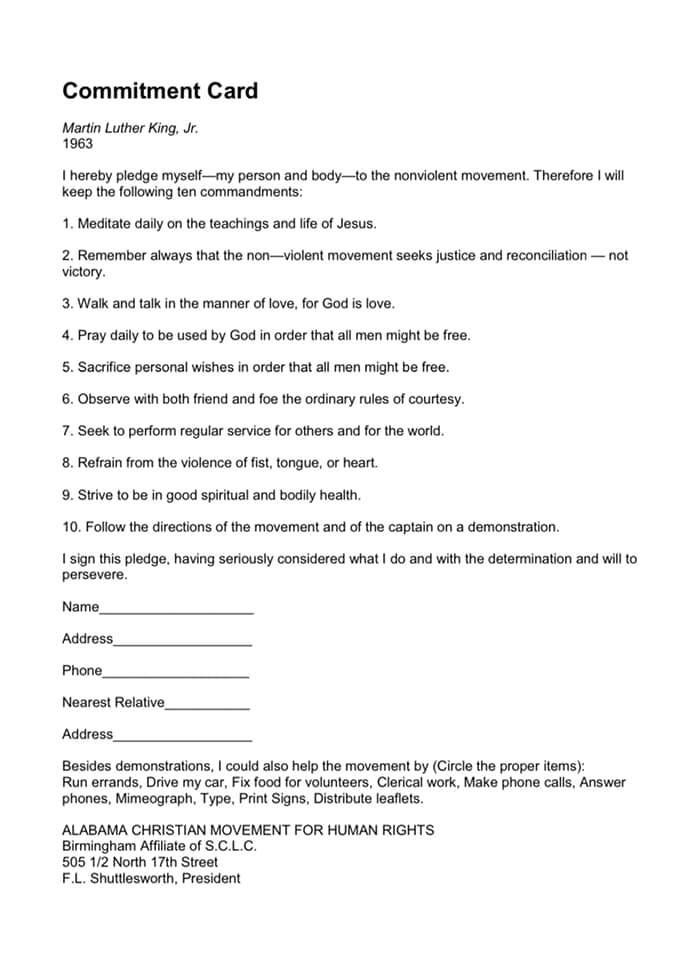
Dear Sister, Thank you so much for this more nuanced picture of the conflict that faces us. Dr King's Commitment Card would make a great poster to carry for any marcher at Friday's actions. Despite the harm of our collective past, we, as a country have a wonderful tradition to guide us in these times.
Oooh, Courtney. This, this, this. I especially loved the provocation that is the pledge card, right after this piece. There is so much growing we are all called to do right now. I really appreciate your meditations here, friend. <3