

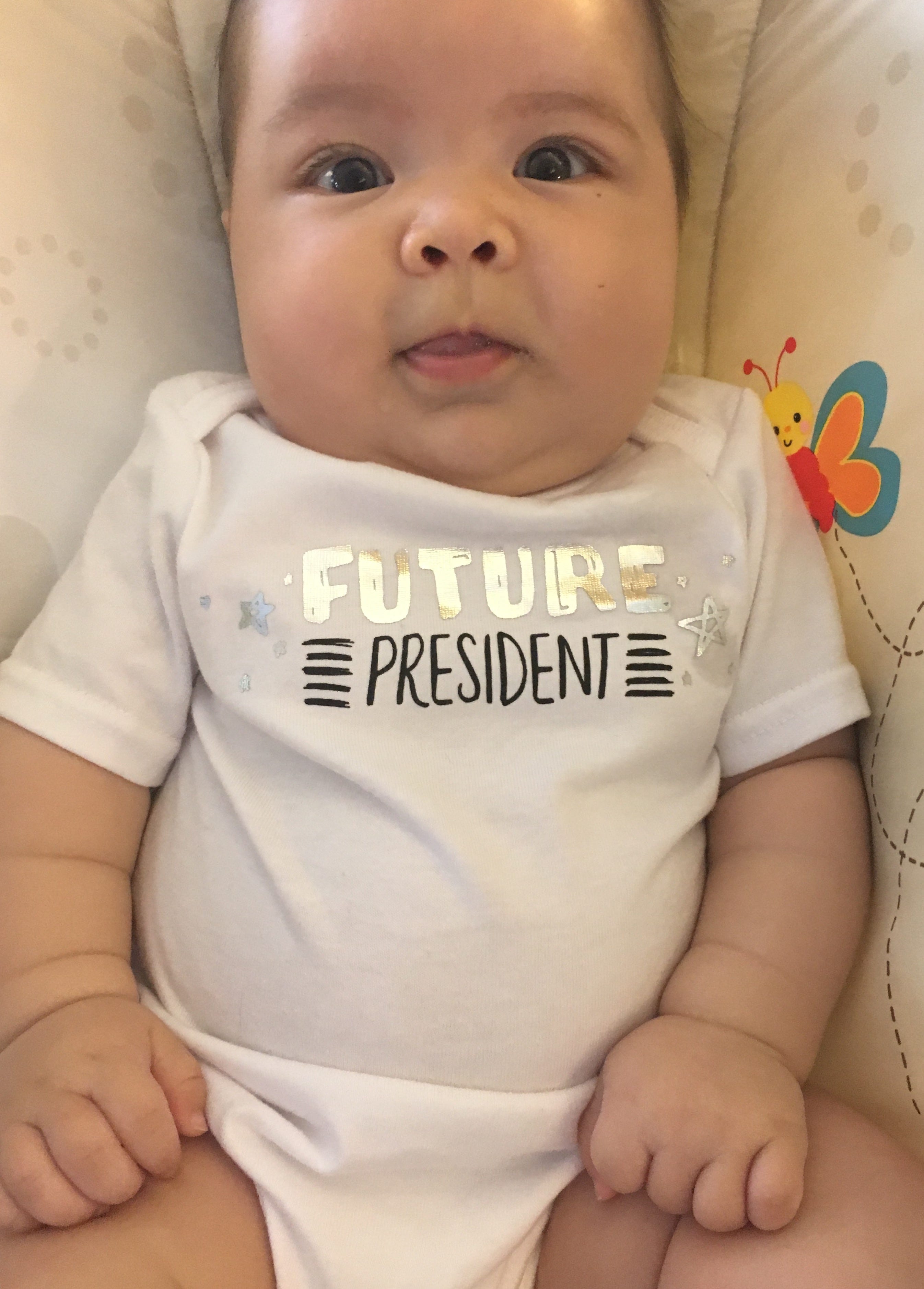
I often look at this picture, right before Trump was elected for the first time, and let my heart break a little all over again. I really thought that my daughters’ first conscious memory of leadership might be an imperfect, but badass woman. I guess that woman is me—the co-leader of our little family. At the federal level they learned that bullies often win elections. It’s hard not to feel like I had daughters at the exact wrong moment.
But then I read a book like Amanda Hess’ new one and think, “Oh wow, I’m glad I didn’t have my daughters even a few months later.” I never used a breastfeeding app. I never had to decide whether to shell out for a Snoo. The most technically sophisticated thing around were those Swedish snot suckers, seriously. It was like the golden age of data-less parenting.
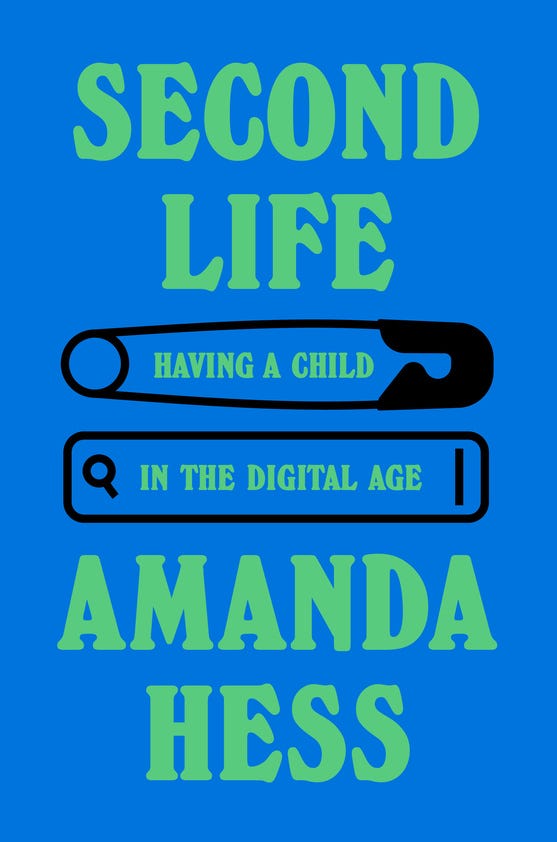
Or at least that’s how it feels as I read Hess’ always entertaining and exacting writing. I have recommended the book to so many friends who are just now becoming moms, and I knew I wanted to share a Q&A with this brilliant cultural observer with you all. So without further ado, meet Amanda Hess author of a new book, Second Life: Having a Child in the Digital Age, out yesterday…

Courtney Martin: As I was reading this book, I kept wondering about the making of it. You are writing about one of the busiest and most information-filled moments in a person’s life–pregnancy, four trimester etc., and yours was made even more complicated by learning about your first child’s disability and intervening with it in various ways. How did you piece this together? Were there a thousand random memos on your phone?
Amanda Hess: I started writing the book in emails to myself — I created a special email address that was only for talking to myself, basically — and I took lots of photographs and screenshots of what I was seeing on my phone. I didn’t exactly know what I was doing at first, and when I started to realize I might be assembling material for a book, I didn’t know what it was about. So I have thousands of random emails to myself about, like, a toddler boy’s haircut style that was advertised online as “Dinner at Grandma’s,” which amused me but had nothing to do with anything. As the years went on, the emails got longer and started to resemble lines and thoughts that actually made it into the book. The task of sorting through all of those notes and screenshots and distilling those flashes of observation into arguments and chapters was a huge lift, and I definitely wished I had observed less, but I didn’t know at the time which parts would be relevant to me later.
If you had a friend who was pregnant right now and said, “Okay, which apps or products are really worth investing in for new parents?” what would you say?
I’m a big fan of simple technologies that just do what they say they’re supposed to do and nothing else. I love our cheap audio baby monitor, which functions pretty similarly to the very first baby monitors that were manufactured 100 years ago. So many of these gadgets are larded with advanced data collection and machine-learning functions — innovative nonsense that might excite a venture capitalist but truly has very little utility for parents, beyond automatically producing, like, a nightly Buzzfeed-quiz-esque report on your baby’s “sleep personality.” It took me a while to understand that desiring a certain technology was not the same thing as the technology being useful for me or my family. Of course I want to be able to look in on what my kids are doing in their bedroom sometimes, which is why it’s helpful for me not to give myself that capability.
You took a deep dive into the freebirther movement, where women birth totally alone on purpose, which I knew nothing about and found fascinating. It feels like one step beyond the natural birth/breastfeeding worshipping-culture in the East Bay where I birthed a couple of kids. Mostly it seemed like you ended up feeling alienated from that community, but was there anything you walked away with from them that feels valuable in terms of how you see yourself as a mother?
When I first started poking around into natural birth communities online — and their most extreme expressions, which include things like rejecting all prenatal medical care and childhood vaccines — I felt pretty bewildered by them, but I caught a glimpse of myself in them, too. I had very intensive medical care and surveillance during my pregnancy, which I was really grateful for, but it also made for an incredibly destabilizing and even traumatic transition into parenthood. I don’t think I’m alone in that. Recognizing a part of myself and my experience in this really foreign movement was clarifying for me, and it pushed me to try to better understand the roots of some of these attitudes, like the anti-vaccine movement, which I might have previously dismissed as simply insane. I can see now how it’s so wrapped up in all of these American traditions — the expectation that mothers be perfect; the extreme stigmatization of disability; the eugenic fixation on physical purity; and the commodification of medical care, which corrupts so much. Only by digging deeply enough in there was I able to recognize those attitudes in parenting practices that are pitched as scientific and progressive, like the genetic testing industry and the development of smart baby gadgets.
You wrote, “Sometimes I wonder whether these instagram experts were so popular because they made parents feel like they were looking out for their children even if they were just sitting in the office, looking at their phones.” I had to put an exclamation point in the margin next to that zinger. You don’t really address phone addiction head-on in the book, but it’s sort of the fog that hangs around. How do you think about the intersection of parenting + phone addiction?
So many of my feelings about modern parenting are caught up in that one line, and I’m still trying to untangle it all. I see phone addiction as a very blunt expression of all of these entrenched problems with the American parenting model — the expectation that parents work constantly but also spend more time caring for their kids than previous generations; that they will be blamed for any undesirable or stigmatized behavior or trait exhibited by their kids; that they manage all of this in isolation, without burdening or inconveniencing anyone else; and that any assistance with childcare is a commodity to be purchased at such a high cost that it only reinforces the demand to work more. The phone is our sad little magic tablet that promises to resolve these tensions: it lets us work while we’re with our kids, and to seem to parent them when we’re at work. It helps us to feel as if we’re cultivating a community while we’re going it alone — but a community that can’t offer real support, only lots and lots of advice.
You also wrote, “The solution to the selfishness of parenting culture was not to drive families further into insulated private lives. It was to rebuild the public world for the collective benefit of all people. And children are people.” I loved that so much and it felt very in line with what I was trying to explore and argue in Learning in Public, my last book. Since you’ve finished this book, what are the ways you are leaning into that wisdom in your own life?
For me it’s getting involved in a mutual aid group in my neighborhood, one that is specifically attuned to the needs of children and families. I believe that a just society would be organized, as Marx put it, “from each according to his ability to each according to his needs,” and these groups put that into practice right away. Often they’re organized on Signal or WhatsApp or Slack, but they so elegantly reverse the poisonous individualism of the mainstream parenting internet, which drills parents to focus so intensely on their kids’ needs, real or imagined. Just being plugged into the wider needs of the neighborhood has been helpful in finding small ways to align my family life with a communal life, and to bring my kids along when I can — or pay a little less attention to them when I can’t.
And if you want more Amanda Hess, check out my friend Sarah Wheeler’s great conversation with her at Mother Of It All:
I love this piece, Courtney. As a grandfather (formerly a stay-at-home Dad) I am interested in how parenting is for our sons and their partners. I forward the piece to stimulate some conversation. That is worthy and loving in itself. The impossible expectations placed on parents, especially mothers, is excruciating. Though these have been longstanding, the pandemic seems to have made this even more apparent. I love that Amanda Hess can cite Marx. In these times, calling someone a socialist seems to be about the worse thing you can do, yet very few Americans have ever met a socialist. Sorry, that was an aside. Nonetheless, "from each according to 'his' ability to each according to 'his' needs is a very different way of looking at what young mothers (parents) need compared to the existing societal structure that exists. More importantly, can we look at this long enough - walk in another's shoes long enough - to commit to a certain level of 'deconstruction' so that we might create healthier, more just ways of living? Forming a mutual aid group in the neighborhood is a wonderful example. Happy to report that our youngest son and his partner are raising their child among just such a group. Seeing that is so encouraging, so hopeful for this grandfather. PS and your book on public education is brilliant.
This was so important and timely for me as a new parent. I would love an examined family / mother of it all crossover on phones and parenting in a digital age.