
Memory / care
making grief visible

This one took a lot of courage to write. I hope it resonates, and if it does, please subscribe and share with someone you think might need it, someone who is grieving (probably invisibly) and needs to know you know.
An old woman with stringy, gray hair and an ocean blue fleece coat on stands next to her walker and moves her arms as if they are riding waves of inspiration, singing, but not really singing, “My Way,” by Frank Sinatra. Next to her is another woman—this one much younger, fuller in body and full of life, wearing a coral jumpsuit, belting out the lyrics with precision—I’ve loved, I’ve laughed and cried. I’ve had my fill, my share of loving. And now, as tears subside, I find it all so amusing. An old man wanders in wearing a brown wool hat with two sprigs of purple lupine sticking out of it. He smiles at the two women singing Sinatra and starts singing along, pointing at them to boost their confidence. A young man walking through the hallway pulls over and joins; he’s young and svelte, wearing an outfit that makes him look like he’s headed out for a game of pick-up basketball, but really he works here, too, like the woman in the coral jumpsuit. As I was shuffling along the asphalt next to my dad in the courtyard an hour earlier, he stopped to pull my dad’s pant legs down over his ever skinnier ankles and said, “Hi Ron! Looking good!” And my dad said, “Uh huh.”
This is where my dad lives now. This is his community. And so I am learning it—the customs and characters, the moods and rhythms. And it is so sad and so beautiful all at once, and it’s happening all the time, 24 hours a day, even when I’m not there, and we—the collective younger, healthier we that are doing zoom calls and stressing about our taxes and making dinner—are not only not there, but not even conscious that “there” exists. That 75 dying people and their very alive caregivers are in a building in Fruitvale shuffling on the asphalt and asking so many questions and listening with such unhurried attention and changing Depends despite agitation and making lentil soup that goes in little bowls for each community member and making art that is genuinely beautiful and weeping and laughing and singing.
I had a dream the other night that I was at an artist’s residency and one of my dearest friends, Wendy, introduced me to a performance artist who was also at the residency. This woman had had a miscarriage and she was adhering prosthetic bellies to her painfully flat belly along the same timeline that her belly would have grown should her pregnancy have remained viable. I told my brother about the dream the next morning and then said to him, “I mean, I know it was about grief, but what does it mean?”
And as soon as I said those words out loud, I knew exactly what it meant: grief is so often invisible. It is the absence of a growing belly, the dying dad living in a memory care facility, the love you never had.
So maybe this post is my prosthetic belly, telling you—my dad is dying and my family, despite so much collaboration and resilience and support, could no longer care for him at our house without maybe dying ourselves (I know this sounds dramatic, but it’s true in various important ways that caregivers for people with dementia understand). When I asked my support group— “How do you know if it’s time for your person to go to a memory care facility?” They said, “If you are asking this, it is past time.”
And I know that’s not always true, but I think it’s almost always true. I told the elder care doula I’d been talking to that I was 80% sure it was the right decision and 20% of me felt like a failure, felt like I could figure out one more thing to make it work, might be able to dig deeper in one small part of my spirit to withstand the constant state of crisis. Did I really need to travel? Or work? I knew I needed to pay attention to my children, and perhaps that is the only knowing that saved me from full-blown martyrdom. She said, “Oh sweetie, I get that, and it’s not a failure. You’re not the problem; the disease is. And, yet, the 20% is not going to go away. You have to bring him on Monday with the 20% riding right next to you. It might never go away. And that has to be okay.”
When we dropped him off—my mom and me—she told the staff how he wanders at night sometimes and one of the caregivers said, “That’s fine. Let him wander. Maybe we make him a warm cup of milk and guide him back to his room.”
I wept then. And especially when the founder of the community said, “Maybe it will be a challenging adjustment. There will be a lot to get used to. Or maybe he will melt like butter into the community.”
I think maybe it’s been something in between a challenging transition and melting like butter. His health has taken a dip—he has almost no words left, he is a fall risk—wobbling and shuffling his way through life now, they sometimes have to feed him. But he seems content. There’s a sort of peacefulness about him—like he’s let go of some things. What those things are, I’m not sure. Maybe just as we let go of him a little, he let go of the need to try to live for us. He has one foot in some other realm, and one foot here on earth, and he seems calmer for it.
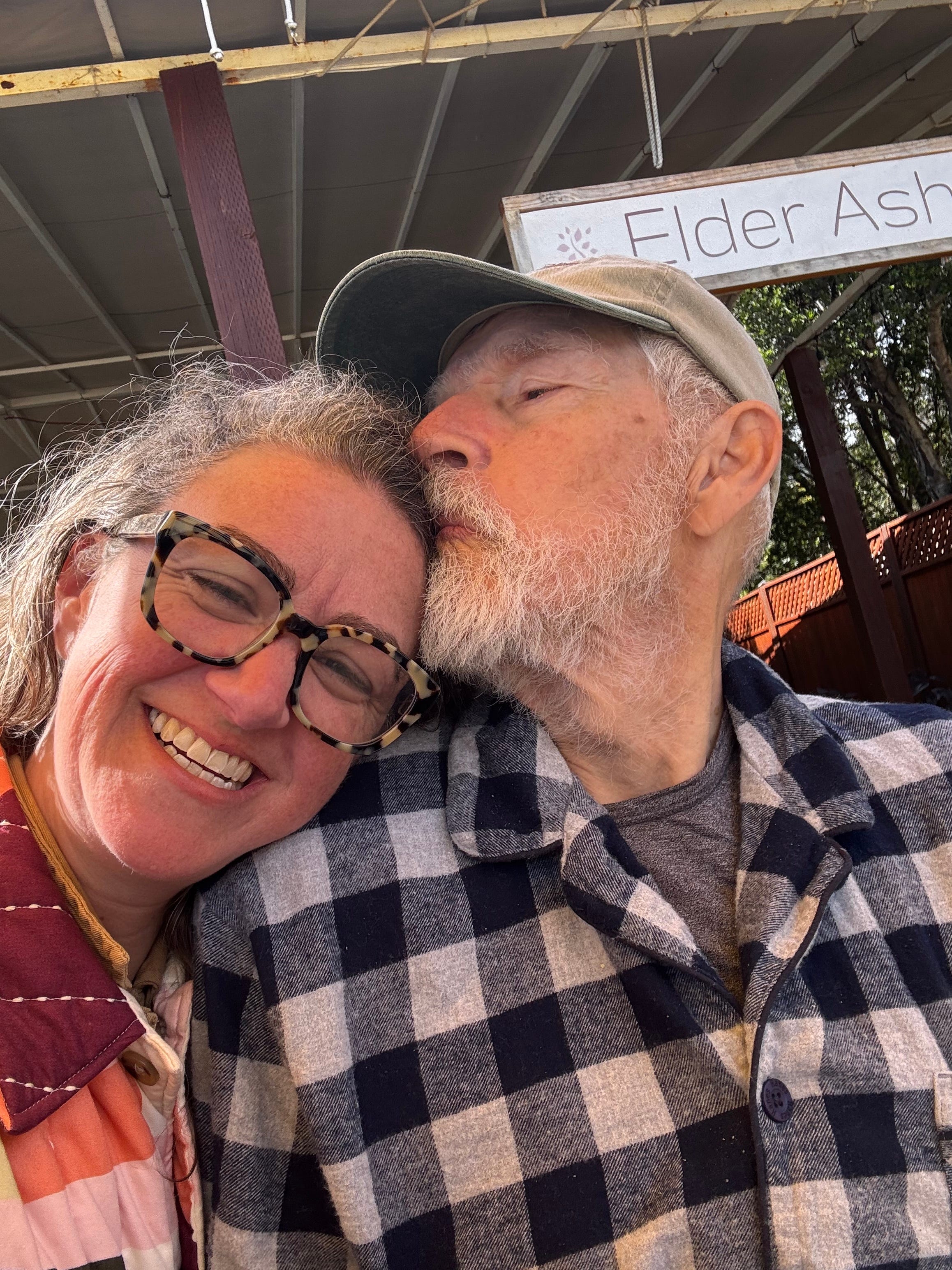
We found this beautiful place—called the Elder Ashram—started by a computer engineer who left her job with a knowing that she needed to create a place where elders could age and die with the dignity they deserve. And she has done that. It is a miracle. It is a totally normal building filled with the spirit of a completely abnormal and transcendent mission—to treat 75 people as they deserve to be treated in the very last scene in the very last act of their lives. It is both assisted living and memory care, all mixed together with no locked doors or differentiation. There is art on the walls everywhere, made by the residents. There are flower petals in the hallways, spread by the residents. There is live music constantly, singing, drumming, dancing, and the expectation that everyone will die soon, so be sure they get the cup of coffee they want if they want it.
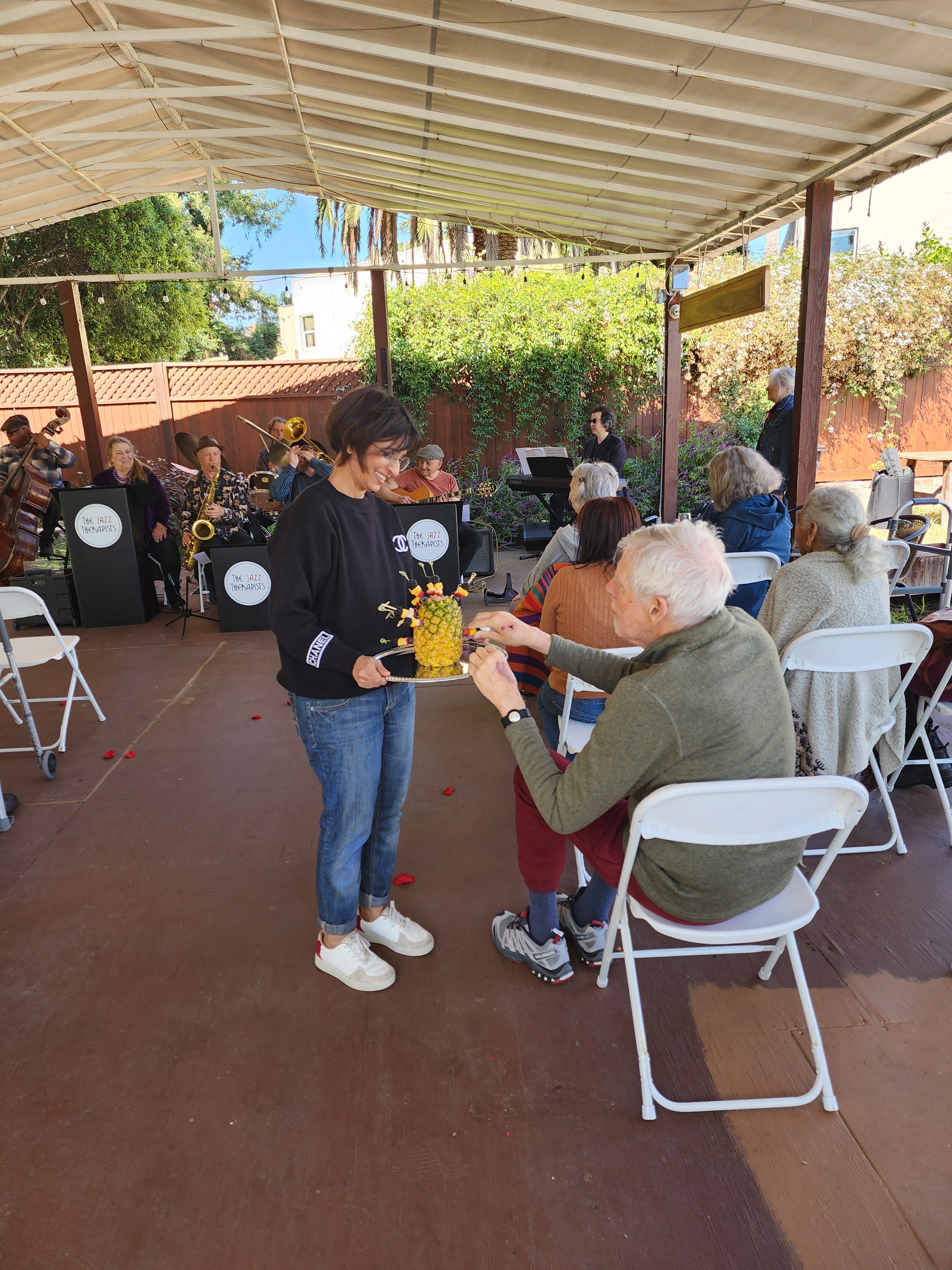
What you really notice, when you are there, is not just the residents—who are delightful and disabled and weird in so many divergent ways—but also the people who work there, who seem remarkably at home. It is a worker-owned facility, a place where the hourly workers have a real financial stake in creating sustainability, and a real spiritual stake in creating delight. And it changes the place at every level.
I sat there Friday afternoon in between my dad and a new friend, who also has dementia and fabulous designer glasses and a red quilted coat with a faux-fur lined collar, and sang Sinatra, and The Righteous Brothers, and the Beatles (special request for my dad). I only cried once, but it was almost from happiness. Or maybe it was from sadness. Or maybe both. The thing about grief, made visible, is that it’s made up of all the things a human can feel. Which is part of why it’s hard to talk or write about. It’s the most four-dimensional experience I’ve ever had—the gratitude and sorrow and exhaustion and love all knotted together and pulsing pulsing pulsing under the din of your days with no clear end in sight.
It must be borne with others. That’s the essential wisdom I’ve come back around to yet again. Even though my grief is entirely, uniquely my own, I can do nothing alone. I love my dad beyond life. And he is dying. And I know you know how I feel, and you absolutely don’t have any idea how I feel. And that’s the paradox of loving and dying in this one finite life we are all lucky enough to get relationally destroyed by over and over again. It’s so unbearably, idiosyncratically sweet and it’s brief and out of our control. So sing.
loving someone through their dementia is like pregnancy in reverse, watching a person be unmade, bracing yourself for milestones while knowing your person will do it in their own time and their own way.
grace and peace to your whole family through the next stages and thank you for the gift of your words.
"It’s the most four-dimensional experience I’ve ever had." That sums it up beautifully. I am so glad for all of you that you have found such an amazing and compassionate place for this next chapter. You're right, I know how you feel and have no idea, all in the same breath. That is the dance, isn't it?