
Living, Together
Q&A with anthology editor and creative living catalyst Samantha Paige Rosen

I so love being able to devote the time to read books and bring you interviews with their authors and editors. As you can imagine, it takes me some time to do so as thoughtfully as I want to. I really invest energy in honoring those who put this work out in the world by engaging deeply with their material, and also honoring you all, my faithful Examined Family readers, who I know benefit from these little tastes of vision and humanity underneath the daily headlines. Subscribe today, or if you’re already a subscriber, switch to paid. It helps me keep me reading closely and questioning widely.
If you’re struggling with something, chances are the answer in some way, shape, or form is community. Or at least that’s been my experience in my 46 years on this too often lonely planet. When I got confused about where to send my kid to school, I found a rag tag group of parents all over the country that were committed to being a force for integration. When I fell down the hell that is our elder care “system,” I found solace in day programs, support groups, and all other manor of collectivizing. And when I was pregnant and in my late 20s, trying to figure out how to be a grown-up, you better believe I jumped on the chance to live in intergenerational, interfaith cohousing with some intentional community veterans. I lived there for over a decade and it completely transformed how I understand abundance, cooperation, and, yes, the many uses of homegrown kale (true to stereotype).
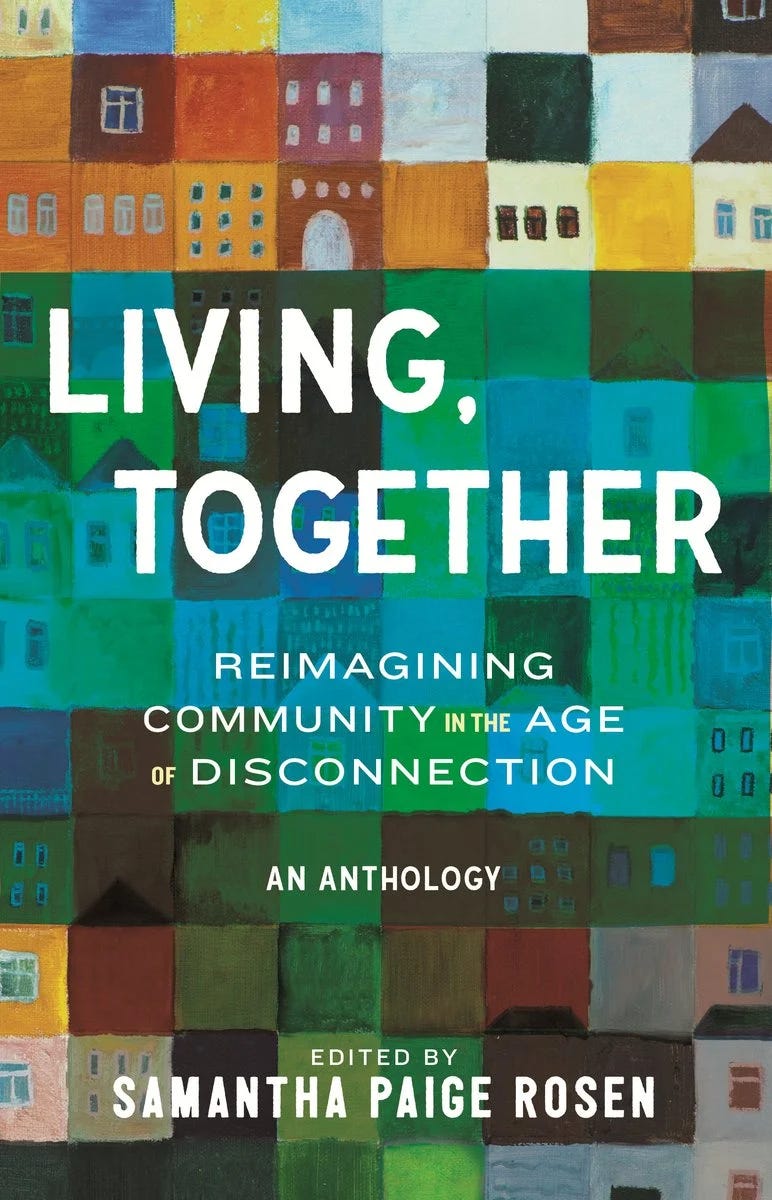
So of course I am over the moon about a new anthology, Living, Together: Reimagining Community in the Age of Disconnection, just out from Beacon Press (who also published my book, Do It Anyway, back in the day). Living, Together features a few of my favorite contemporary thinkers on interdependence, including Rhaina Cohen (author of The Other Significant Others) and, as mentioned, Dani McClain.
The *Other* Significant Others

Anyone who knows me knows I love my friends. I prioritize them. I take pride in nourishing them. I am nourished by them—meals and herbal tinctures and voice texts and personalized gifts and, most of all, witness over years and years. It’s something I watched my mom prioritize as I was growing up—the sound of women’s laughter wafting up from downstairs l…
I will be publishing Dani’s gorgeous essay about multi-generational living on Friday. In the meantime, here’s an interview with the anthology’s editor, Samantha Paige Rosen…

Courtney Martin: You begin the book talking about your own pleasurable experience of living with your parents as an adult—something that grew out of crisis, but has become a choice. It seems that in the case of multigenerational households, part of the challenge, is rewiring adult relationships and not falling back into early conditioning. How did you do this re-wiring when you all lived together as adults?
Samantha Paige Rosen: For me and my parents, I think a handful of different things occurred. First, some of the re-writing began before I moved in with them. I lived with them for nine months when I was 24 after I returned from the East Coast and was considering a career shift. I stayed with them during the summers I was in graduate school for the next couple of years, and I did the same for most of my college summers. All that time, they were seeing the adult I’d become and I was seeing them with emerging young adult eyes. I think this cemented the adult-level friendship between us so that by the time I moved in at 29, after which I ended up staying for six years, we could build off of the re-wiring we’d already done.
Another piece is communication. I love talking about my feelings and my perspective, and I want my loved ones to feel comfortable doing the same. So as much as my mother likes to joke that I talk everything to death—and I know I have to pick my moments; not everyone is receptive at every moment—I attribute the way we understand each other as adults to my communication skills and my parents’ openness to that, much of the time. What that meant was that when there were instances over the six years I lived with my parents where my mom doted on me like she did when I was young, or my dad was a little too opinionated about my whereabouts, I could remind them, thank you, I love you, and as an adult, I’ve got this! If they’d make an assumption based on how I acted when I was younger, I’d call them out on it, nicely, and let them know that the thing they’re saying isn’t true of 30-something me. Of course this goes both ways, and I let my parents know they could call me out too. I worked hard to make sure I was seeing my parents as the fully-realized adults they are and not just my mom and dad.
At the same time, I’ve always said that neither of my younger sisters could have lived with my parents as adults, but I obviously could. I don’t always need to be in charge and I don’t mind a little doting! My sisters prefer to run the show and feel strongly about their independence. So perhaps there was an element of luck, personality-wise, too.
For readers who live in multigenerational households and have the difficulties around re-wiring, I’d say tell and show your loved ones the ways you’ve changed—and often—and ask them to do the same. Communication is everything (and when that doesn’t work, demonstration is). And are there minor aspects of falling back into early conditioning that wouldn’t be so terrible to embrace?
It seems like one of the biggest barriers for so many people to live more creatively and interdependently is cost. Cohousing, for example, is notoriously expensive to create and is still too elite a movement, as a result. What did you learn about the role that finances play in our ability to, as the subtitle says, reimagine community.
I relate to feeling priced out of communal living. I remember my college friend, Francesca, sending me this article about cohousing when I was at my most overwhelmed and depressed living alone, about six months before I ended up moving in with my parents. I had never heard of co-housing; she saw I needed communal living before I did. I remember feeling enraged, honestly, because she was like, “this is what you need!” and I felt like, why did you make me aware of something I clearly needed but couldn’t afford?! The subtitle of the article was literally “Where Responsibilities Are Shared And Life Is A Little Less Lonely,” and I was so lonely, overworked, and just kind of crushed by the weight of life.
But a few weeks into living with my parents, I realized I was living communally, just in a different way. And now, I live alone in a townhouse and my parents live across the parking lot. We have dinner at least twice a week, we share groceries, we pet sit for each other; I take my cat there in a backpack every day to play with their cats. Some people might say I live alone, and in some ways I do, but I can still reap some benefits of communal living in an informal way and that I can afford.
I’m not going to pretend that finances don’t offer access, or at least a wider ability to reimagine community. But only a few of the stories in Living, Together feature forms of intentional community that can have a high price for entry, like cohousing. That’s by design: I wanted readers to feel like they had many different models for getting their needs around communal living, and even community outside the home, met.
In the book, Amanda E. Machado and Rhaina Cohen both share stories of renting homes with friends, and Amanda’s essay, in particular, talks about the cost sharing element of that approach. Essayist Elizabeth Hart Bergstrom lives in a separate space above their parents’ house, and Dani McClain shares the house she grew up in with her mother and daughter. Gabrielle Korn has a house with an attached studio apartment she rents out, and also offers for free to writers seeking short residencies. Suanne Carlson shares a glimpse into the nomadic life, which I think more people are going to be forced to do if this housing crisis continues; for Suanne, living out of a vehicle is a choice that allows her to travel, feel at home in nature, and get together with other nomads who see home and community the way she does. Tiffany Harris writes about how she made a career out of how much she liked having roommates by supporting programming for Jewish people in their 20s who want to share living space and traditions with other young Jewish people. Simone Gorrindo writes about having an interdependent relationship with a neighbor when they were both new military wives and were incredibly lonely.
All of these forms of communal living have pluses and minuses. There’s no perfect way to live and when you’re interdependent with others, there will always be friction. If you want the kind of communal living where you have completely separate space from other people, then yes, it could be more expensive (although not necessarily: tiny house communities? Fourplexes? Accessory dwelling units? Separate apartments on the same floor as loved ones?) But there are so many other ways to live communally if you think outside formal intentional communities and realize you can…make up whatever you want!
[Here are some resources on making cohousing more affordable FYI.]
You really wanted the anthology to disprove the notion that communal living is something only hippies and religious folks do, and you succeeded wildly. Was it hard to find such a diverse range of voices for the anthology? Is there any theme or kind of person that you were hoping would be part of it but you just weren’t able to land?
I’m really touched to hear you think I succeeded in this area! I was so intentional about it. Yes, it was incredibly hard to find the diversity I was seeking. For probably a full year, I kept my eyes and ears open no matter where I went. I also did tons of research. And I crowd-sourced: “Hello, acquaintance from college! You live in X part of the country. Know anyone nearby who could speak to Y living scenario?” It was a fun challenge—a game, really. Just how many perspectives can I offer and how can I think of unique avenues to find them?
I wish I had an even broader array of geographies, identities, experiences, and living scenarios, but I’m still proud of what I was able to achieve. Across 15 essays and six Q&As, we have 22 contributors ranging in age from 25-91, from 14 states and every region of the country. Contributors highlight topics including loneliness, aging, friendship, chosen family, illness, parenting, intergenerational relationships, artist community, colonization, immigrant community, relationships between neighbors, the challenges of being in the sandwich generation, polyamorous living and parenting, queerness and queer community, financial hardship, the natural world, sibling relationships, and, of course, housing.
Because I wanted this book to be easy to access (not too long or cumbersome to read), there were living scenarios I couldn’t include, yes. I was interested in featuring a community land trust, which has to do with land ownership, governance, and affordability, but it ended up not making sense for this book. I didn’t get the perspective of friends who purchased a home together, although we have friends who rent together. I don’t have a co-op—again, the distinct form didn’t matter as much as the story that was being told about the experience—or a tiny house community, although Mary Anne Adams talks in her piece about plans to build one. I was also interested in people who live intentionally in a fourplex, perhaps seniors who plan to take care of each other as they age, a young person living with a senior in a home sharing arrangement (perhaps reduced rent in exchange for helping with household tasks), and people who deliberately have apartments on the same floor of a complex are interdependent.
What was the biggest surprise of working on this anthology?
Working on the anthology further broadened the way I defined communal living.
I really have come to believe that communal living is any way a person is regularly interdependent with others around their home base, sharing time, resources, and offering a sense of safety.
Maybe it’s several generations of a family living within walking distance to one another, or neighbors who deliberately make time to see each other most days, share groceries or meals, and offer rides to doctors’ appointments. But to me, communal living is less about the roof you have over your head and more about how intentionally interdependent you are with others.
Reading the Q&A with Hank Gamel and Fran Biederman in Living, Together, where Fran, who is 91, talks about all the different ways she and her neighbor support each other got me thinking about this. So did Kristen Arnett and Simone Gorrindo’s essays. Kristen’s friends, her chosen family, all live within a short drive from each other. They celebrate every milestone together and jump at the chance to offer help, like inviting those who don’t have power during hurricane season to the house of whoever does. Simone’s neighbor taught her how to drive and helped Simone furnish her house. For a period of time, they had regular dinners, watched each other’s kids, and Simone even slept at her neighbor’s house on anxious nights while their husbands were deployed.
What is one thing you have changed in your own life because of reading this book? A new tradition with your parents? A new way of using space?
I’ve become more flexible about the way I think about home, community, and my own future. As I write in my introduction to the book, I bought pretty hard into the American Dream as a kid, including the idea of a “forever home.” I think I was seeking a feeling of safety, and the finality of a “forever home” seemed to offer that. But reading my contributors’ stories, seeing their openness to different configurations of housing and home, and the way those changed as their needs did over time, has taken the pressure off of finding that one ideal living scenario.
I no longer feel like I’m searching for a place to settle; I just feel more settled within myself.
And it couldn’t have happened at a better time, because home and housing is so tenuous now for so many of us.
It feels freeing to have my attitude be that right now I live in a two-bedroom townhouse across the parking lot from my parents. It meets a lot of my needs, but not all of them. And when I’m missing having people in my immediate space, or there’s another reason this doesn’t work as well anymore, I tell myself that this living scenario can be for me until it isn’t. When my needs change, I can adapt to them. Someday, I hope to live close to a bunch of artists who also raise kids communally, in whatever form of housing that takes. But not today, and that’s fine!
I’m so curious: what is communal living to you? How do you live now and how do you dream of living someday?
And stay tuned for Friday’s essay. It’s a gorgeous one and we are so lucky to reprint it here. Buy the anthology here—it’s full of goodness, including a fantastic essay from my former neighbor in cohousing, Kate Madden Yee.
I'm just coming off of two weeks building a small cabin on land I bought with my son last year. We've got about 37 acres, mostly woods, and we're hoping over the course of time to build out a small community there with a common house for shared kitchen and full bathroom by the pond at the top of the driveway, and then small cabins sprinkled through the woods for bedrooms/privacy.
Speaking for myself, I want community but also need solitude, which sharing land in this way offers a means for balancing. More so than sharing a pre-existing house. The hard part, of course, is building out all that infrastructure, especially when none of us are rolling in cash. It means doing the work ourselves and having to ask for a lot of help, which would be easier if we were *already* living in community, but is harder when we're all still living separately. In the course of the building, I had to remind myself that it was not unlike when my kids were looking for their first jobs, but no one wanted to hire them without job experience. A Catch-22, that. I'm working towards building out a community within a reality that is not yet communal, and it's hard. I have to remind myself over and over that it's a systemic disconnect and not my personal failing for not (yet) having a perfect communal network to slot into place.
Here's how the build went, if you're curious:
https://ashasanaker.substack.com/p/work-in-progress
https://substack.com/@ashasanaker/note/c-292758791
I could not have lived with my parents in adulthood. But at present I have one adult child permanently living with us, one with us for summer until he heads of in Fall to a teaching job in Chicago, and the third living six blocks from me, whose child is here part of six days a week. In fact I will deliver all his lunch sandwiches for the rest of the week momentarily.
So it is the most traditional kind of community, I guess. Extended family. We are intertwined.
I have always been interested in cohousing, but my own family is about as much as I can extend to continuously.
My husband grew up in a very close neighborhood, which we would have loved to do, but it isn't what we found.
I am happy, though, with the home-hub.