

I love bringing you these Q&As with the amazing people in my wider network—writers, artists, activists, teachers and more. It takes some real coordination and labor. So by all means, if you love learning about people like this, please consider subscribing today and/or upgrading to a paid subscription. Part of your payment gets pooled and donated to an organization of our guest’s choice, as you’ll see in the end of this interview. Thanks for your continued generosity and support.
Full disclosure: the artist I get to interview you to today is a dear friend. In fact, some people in our shared group of friends sort of think of as dopplegangers. We both grew up in Colorado. We are both known for our low-maintenance ways of moving through the world—we’re game for anything, love learning about anyone, and gather compulsively, all while parenting and getting political and loving an early morning hike.
Where we are not the same is how our creativity emerges. I use words. Jen uses imagery. And boy, does Jen use imagery. She has an incredible art practice these days—both as an individual practitioner who is constantly creating new stunning depictions of what is most on her heart and mind, but also as a collectivist, leading kids, community members, activists, anyone and everyone through the clarifying, connecting process of making murals together.
I’ve been witnessing how Jen’s work is able to hold an emotion that I think a lot of us are struggling with right now: grief. I wanted to pick her brain at that particular intersection—how can art be a way for our grief to move and become less lonely?
I adore her and I know you will, too. She’s one version of what being absolutely awake to her own aliveness looks like in this crucible of a time. Meet Jen…
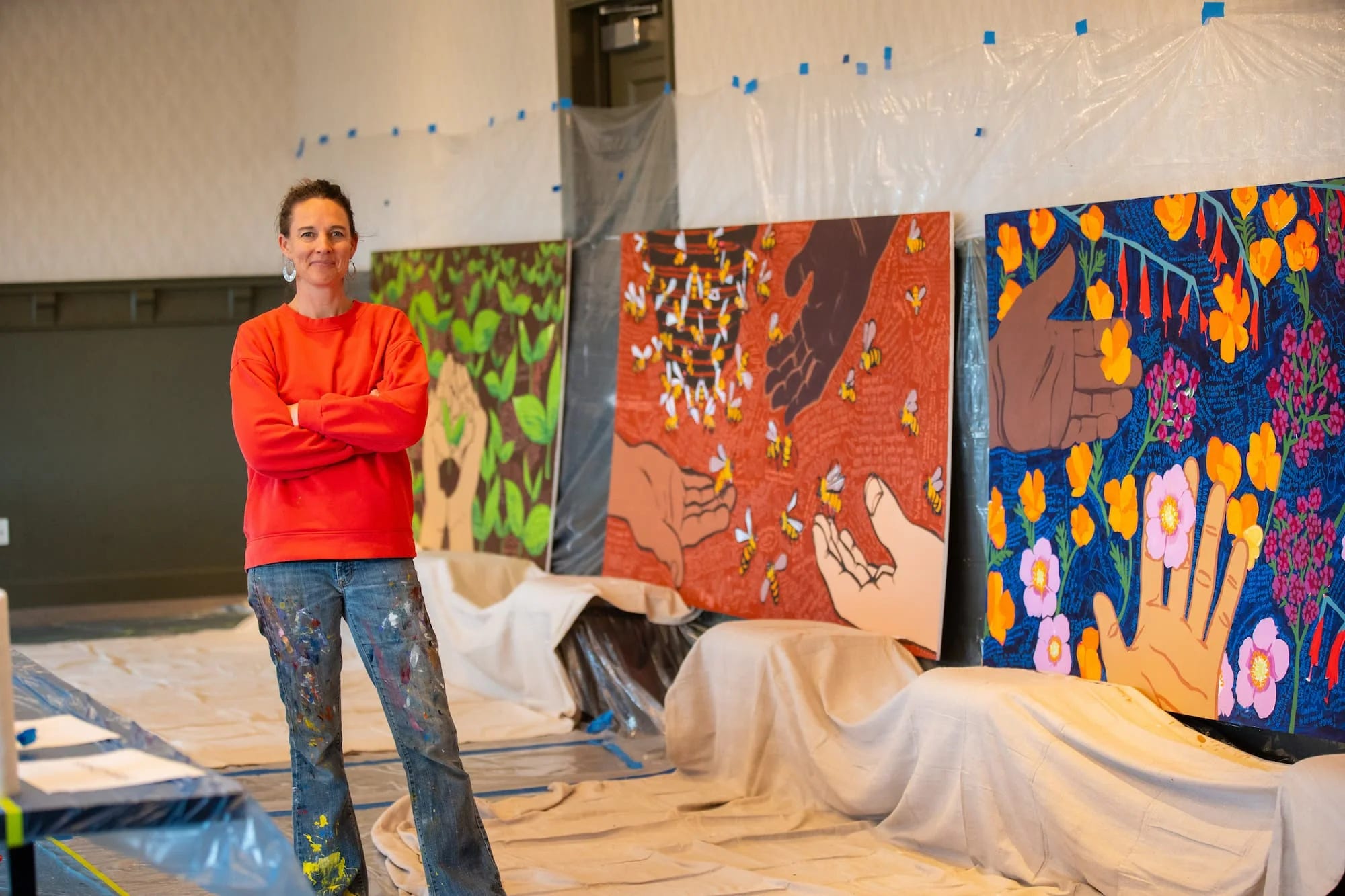
Courtney Martin: Tell me about your recent project that helped a community process their grief through art.
Jen Bloomer: I just finished a piece for the Stolen Summers national storytelling project. It’s a project honoring the people, places, and ways of life that have been lost and stolen due to extreme weather and climate change. They matched 30 of us artists with 30 survivors to create 30 prints depicting survivors’ lived experiences. Each piece represents one million Americans whose lives have been upended by fires, floods, hurricanes, and heatwaves.
It’s been such a powerful project to be part of because it gives people space to share the story of their deep grief. I think we like to distance ourselves from terrible things that happen to other people. I know I have fallen into that trap. [Jen and I cooked up a cool conversation on just that with Nadia Bolz-Weber a while back.]
But I’ve found that deepening our understanding of other’s grief and loss is how we build the energy to work and care for each other afterwards and prevent more harm from occurring in the future.
In the project I was matched with a woman named Bobbie Green from New Orleans who, at just nine-years-old, lost everything in Hurricane Katrina. She has now become an advocate for other survivors of extreme weather. Based on insights she shared from her story, I created a piece that depicts her current self who feels empowered and connected to her community reaching back to support her younger self who felt so vulnerable and afraid. We used Bobbie’s favorite colors, colors that bring her hope and resilience—yellow, purple, pink—and used the art to try to convey the ways her family had supported her in her grief as a child and now she is the one to support them.
You’re trained as an artist and as a therapist, right? I’m sure art is an amazing way to process so many emotions, but why grief, in particular?
Grief is a hard emotion to feel especially if you don’t often give yourself space to feel it. This has been something that I’ve only recently come to understand. I grew up in a family focused on joy and resilience, which on one hand gave me a lot of resilience, but on the other hand, did not give me frequent moments to just be with the waves of sadness and grief that I felt.
The wider community I grew up in also was not doing this aside from an occasional “minute of silence” after which we’d move on to “more important” things. What I like about art is that it takes time. You can’t create a mural in a minute. Art slows us down. It allows us to be with the feelings and practice feeling the things that feel hard.
For many people when they are making art in a safe space, they are able to let feelings out that they otherwise cover up. When we cover up feelings they expand and multiply, when we make space to feel them they can transform into something else. I don’t mean that the grief is gone, but the feelings morph into something that often feels more manageable.
I love the way art holds a mirror for us to better see ourselves and reminds us that things take the time they take. We can’t decide our feelings away, but we can be with them. I need that reminder a lot ;-) [Same, girl, same.]
Do you have a favorite piece of art or artist on grief?
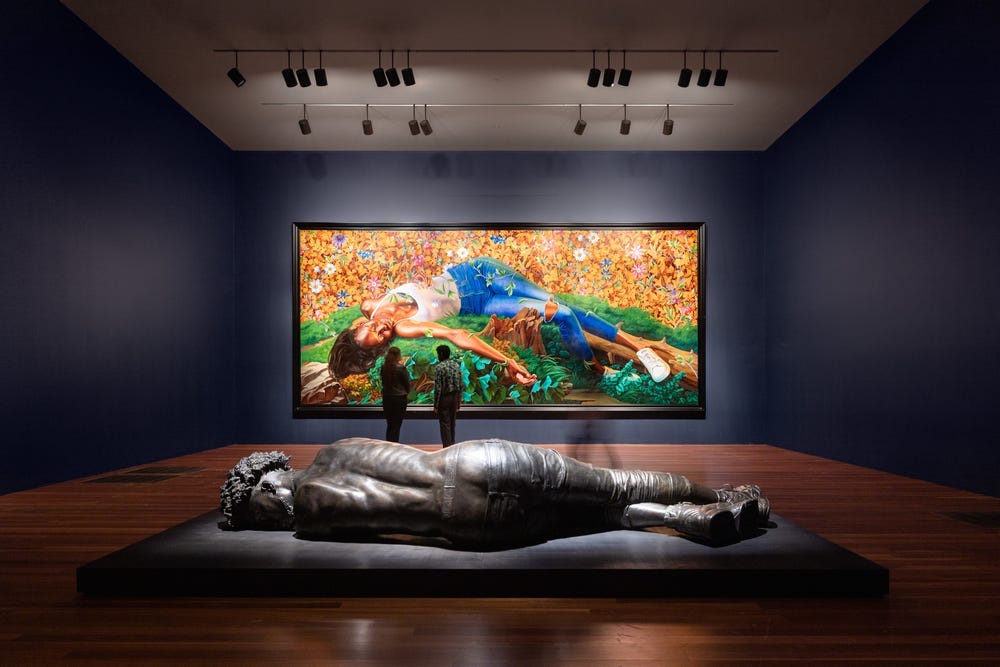
A show that I went to see that I will never ever forget was Kehinde Wiley’s show at the DeYoung Museum: The Archaeology of Silence. After art school where I was told portraiture was dead, it has been thrilling to see so many incredible portrait artists gain popularity in recent years.
The few pictures I’d seen of Wiley’s work with the detailed intricate backgrounds and satisfying renderings had impressed me. This show, though, nearly dropped me to my knees. It called out the silence around systemic violence against Black people by depicting gorgeous patterned backgrounds with figure after fallen figure lying larger than life as the center of each canvas. I remember the dark rooms with lights only illuminating the paintings and I can feel the way my hands shook after walking out of the exhibit. This to me is the power of art. This to me, is the power of an artist to lead you into a feeling and usher you out forever changed.
Do you see your art as a community healing ritual?
I love the physicality of art—sanding, and preparing a mural wall with gesso, for example—it all feels like an important part of the process and feels ritualistic. Humans have been gathering together to collaborate, to celebrate, to organize, to nourish each other, and to make art since the very beginning. I love watching a big group stare at the big wide white wall at the beginning of a mural process and then many hours later step back to admire a finished piece that we all completed together. It feels like a ritual of care. It feels like we are collectively saying: “When we come together we can create something beautiful. Creating together matters. We are all part of this.” And the finished piece is a reminder of that ritual, of that coming together, which we can use as a reminder for years to come.
Tell us about your dad and his amazing art.
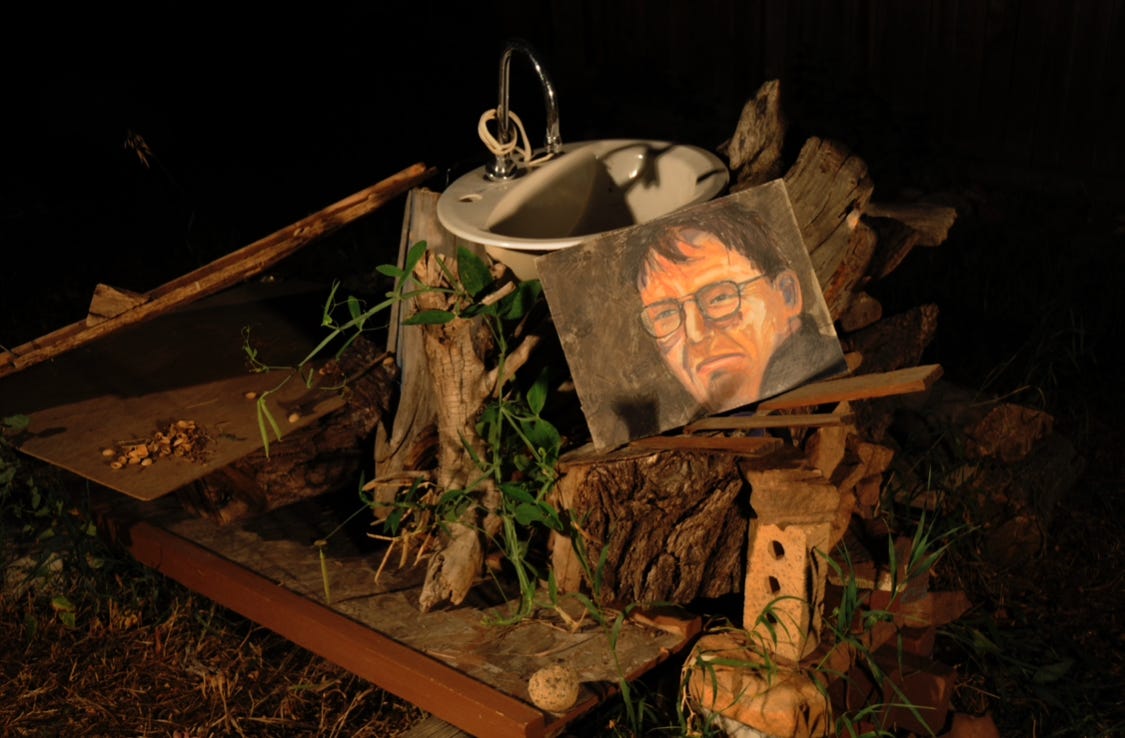
When my dad was 37—an architect with three young kids and so much of his life in front of him—he was in a terrible bike accident and barely survived. He has been living with a Traumatic Brain Injury (TBI) for the last four decades. He started building found object sculptures in his yard. One piece was a tower of all old prescription pill bottles, another one involved an old bike which he hung in a tree, another piece was a mosaic of carefully arranged shards of glass next to an old window pane. My dad lost a lot of his ability to articulate his thoughts, but to me his art speaks volumes.
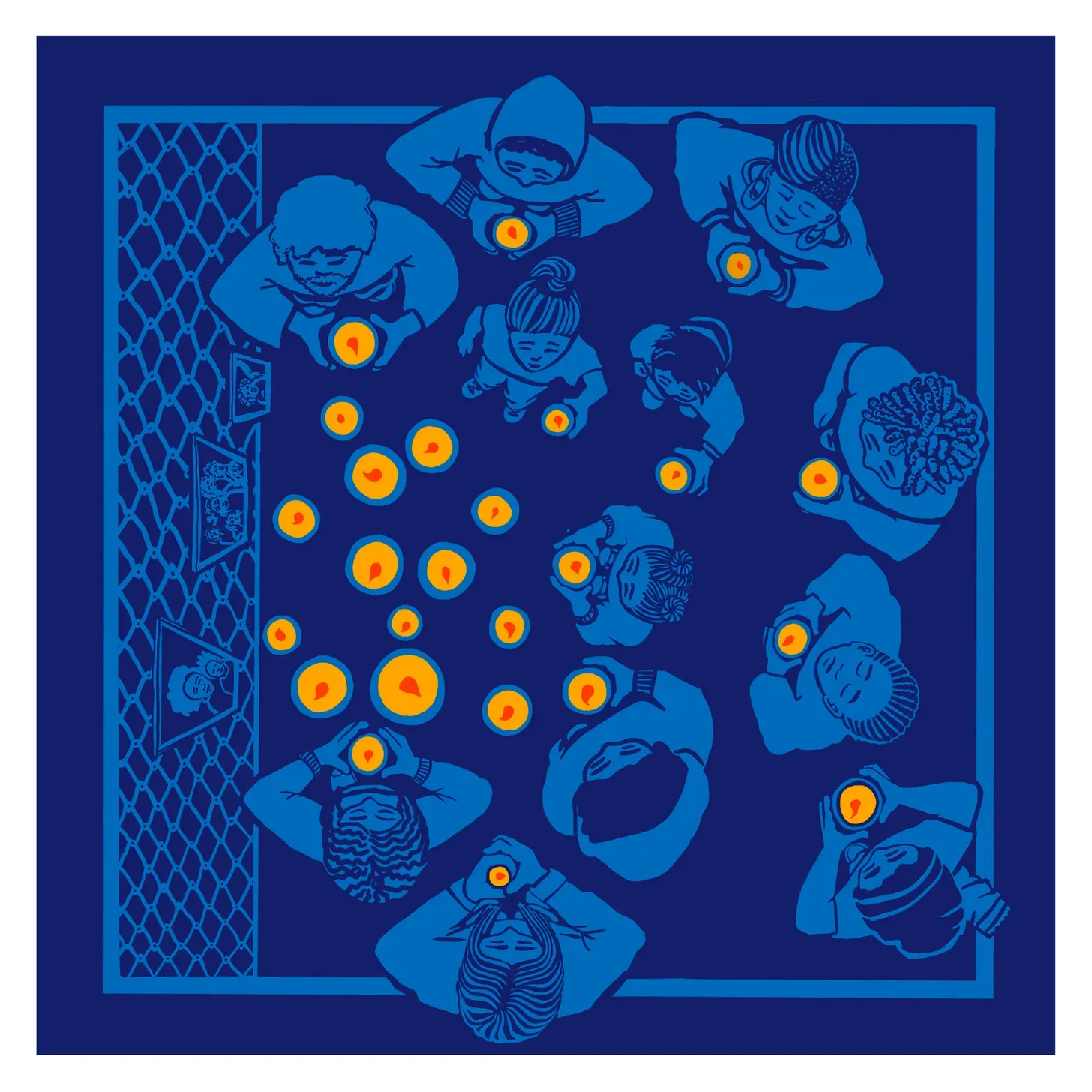
A while back one of his neighbors complained the sculptures looked like junk, so he and I decided to have an art show to lift up what he was doing. I painted his portrait in lots of different ways, on lots of different canvases and then together we incorporated the portraits into his sculptures.
We held the show in his backyard in the evening when we could light up all the pieces in the dark. We invited all his friends and neighbors and also got an announcement put in the local newspaper inviting anyone to come. It was so powerful to see my dad watch all the people come by and admire his art. A woman came up to me and shared that she had seen the announcement in the paper and came because she recognized my dad’s name. She had been one of the nurses who took care of him when he was in the ICU right after the accident. She wanted to come and see what he was creating.
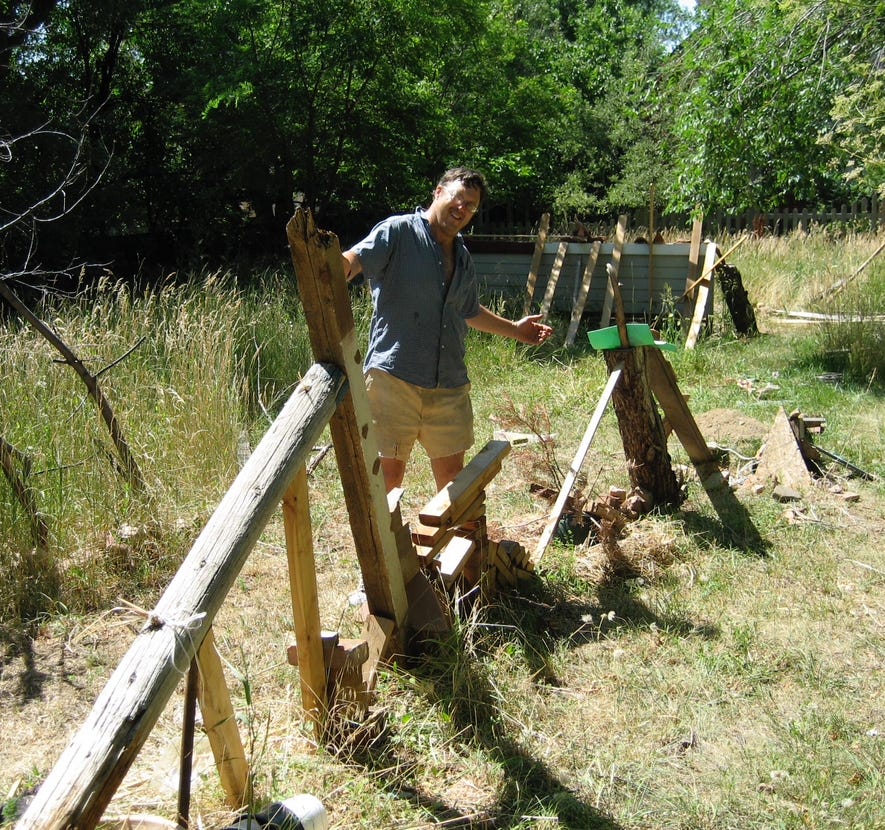
Isn’t Jen (and her dad, of course!) amazing!? Go check out Jen’s work here, subscribe to her newsletter here, and buy her amazing calendar for all your friends, family, teachers, and co-workers. It’s such a perfect gift. You can also listen to more of her on Kelly Corrigan’s podcast:
We have collectively donated to The Loveland Foundation, which provides therapy for Black and BIPOC women and folks who identify as non-binary, in honor of Jen’s labor answering this Q&A.
It's wonderful work, the murals.
If this were in my town, I would volunteer to show up and wash brushes.
I had hoped community art would be something my grandson with disabilities could do to be part of community. While I don't think that will be physically possible, I am so grateful he sings so joyfully. I am hoping music will be a big place of community for him.
The best!!