

Thank you all so much for joining our writing workshop for healers, caregivers, and teachers on Friday. Truth be told, I’d had a rough day, and the gathering totally reconnected me with my heart and my hope. What a gift! We wrote another group poem, this time inspired by Nadia Bolz-Weber’s last newsletter. Read the full think here. A little excerpt for you:
He is turning the pages–from back to the front; focused, curious. The stretched out clouds far far away in the distance form a halo, lopsided and perfect.
A bent woman, maybe 75, pulled out handfuls of birdseed from her cart and threw them as lovingly and forcefully as confetti.
We are stepping on each other’s shoes, swarming the block like lost fish, but no one is in a rush.
I’ll plan another one soon! It’s just such a delight to read your words and to meet so many readers of Examined Family.
There was a phase when my dad was deep in his dementia and still living with me where he would, at seemingly totally random moments, say, “Hush hush,” in a southern accent with a mischievous look on his face. It made us laugh hysterically and he loved that reaction. Like a small child, he would register the mirth on our faces and do it again and again.
My mom had a theory that it was some callback from the recesses of his memories of his mom, who was born in Paris, Texas. There was no way to ask my dad—he was at a point where he didn’t have the power of that kind of explanation for his own behavior. So we enjoyed it and chalked it up to one more absurdist moment in the life of a multi-generational household with dementia and lots of laughter.
One day I stuck his earbuds in my ears so I could see if I could get the sound working on his beloved ancient iPod and I gasped. Bluesman Jimmy Read was belting out, “Hush, hush, baby don’t believe a word / You don’t know nothin’ / But believe everything you heard.”
The “hush, hush” was in the exact same tone as the one my dad had been cracking us up with. Mystery solved.
But also, mind broken open. It made me realize how much of that era of my dad’s dementia was really about being in a “yes, and” improv-like state with him—letting his mind take me where it wanted to go without always trying to make sense of it. That required a lot of time, presence, and patience, which I didn’t always have, but when I could be on Planet Dementia with him, there was a lot of singing, dancing, walking, eating, and laughing.
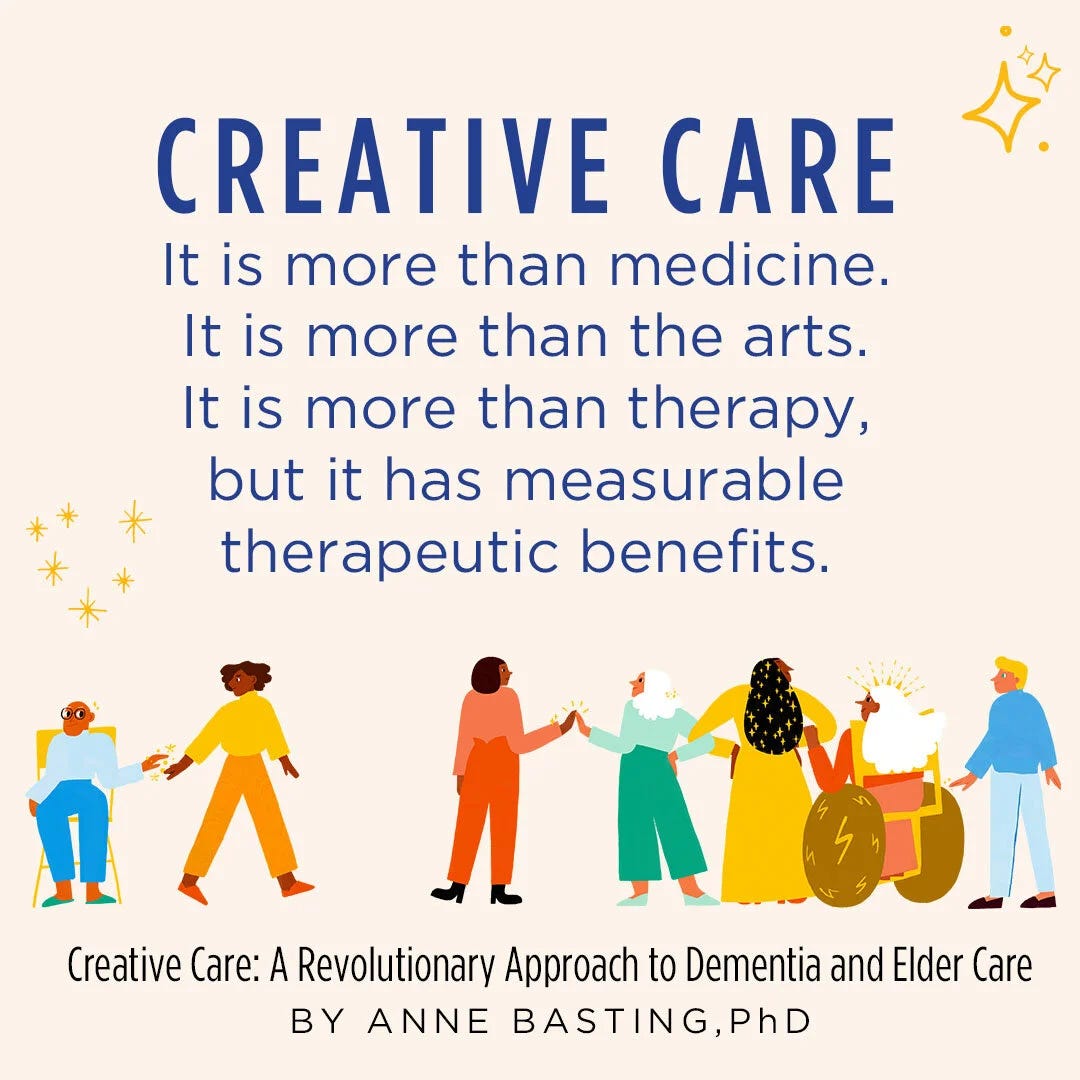
When I shared this quality of caregiving with people, many of the most open would tell me about the work of Anne Basting, a MacArthur genius who has taken on truly radical theater experiments with elders and staff at assisted living homes, staging moving, deep interpretations of Peter Pan and The Odyssey, among other grand artistic experiments. She calls her approach Creative Care, and has written a book of the same name. I fell in love with it when I finally got around to reading it and couldn’t wait to introduce you to her work.
Meet Anne Basting…
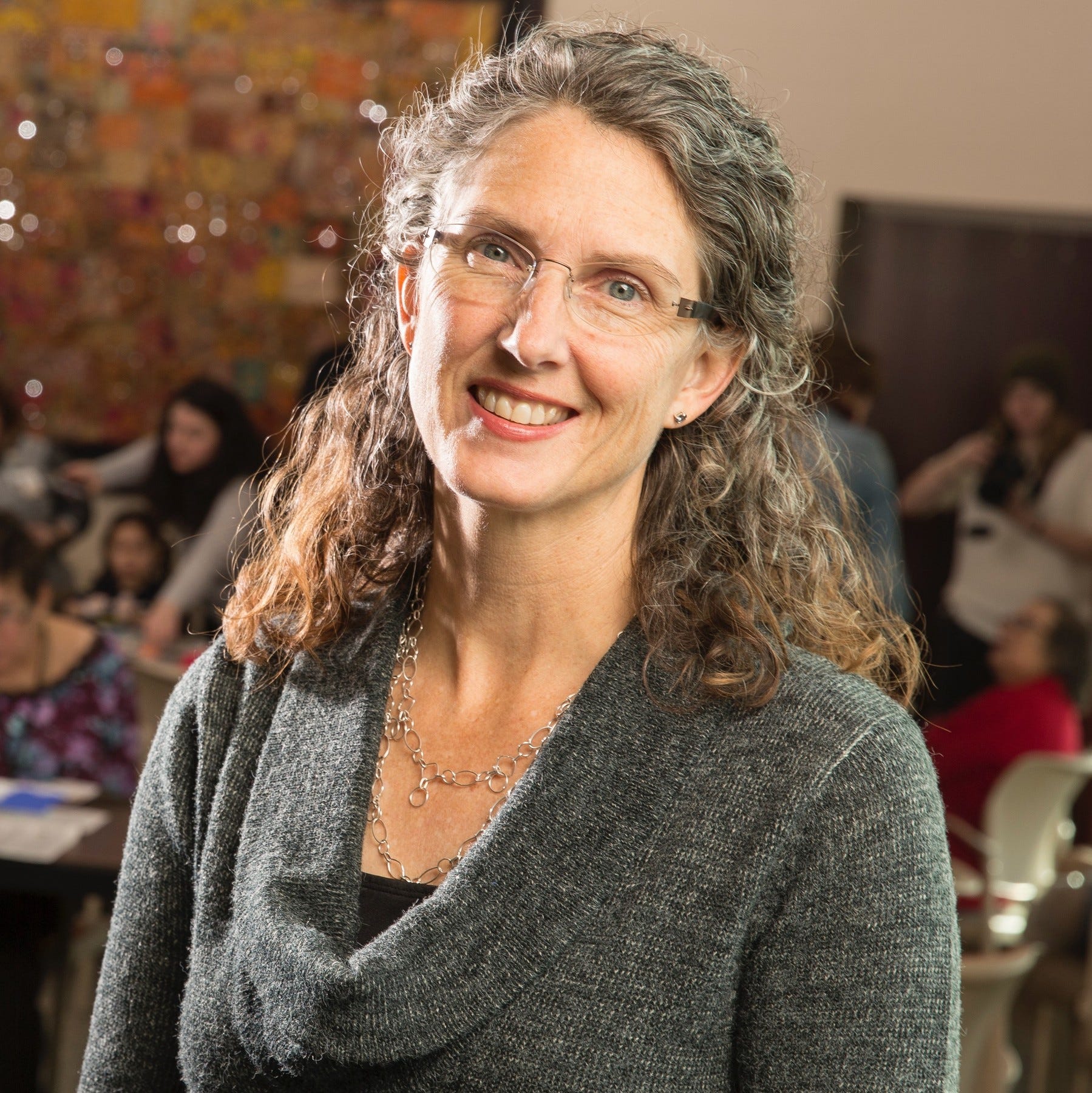
Courtney Martin: You see imagination and play as vital tools of caring for our elders. Both require a certain slowness--sort of a time out of our typical clock time. Can you talk about the way in which your work is countercultural from a temporal point of view?
Anne Basting: Such an interesting question. I simply see the work of Creative Care as opening any given moment to possibility and wonderment. That can be done fast or slow. My amazing colleague Sam over at TimeSlips, the non-profit I work with, has done lots of work with training meal delivery drivers and well-check callers for Meals on Wheels to open moments to meaningful connection through what we call Beautiful Questions. They only have about 30 seconds to connect. We can learn to deepen our engagements by sharing in wonder together. So I see it less about the amount of time you have, than about opening yourself to the possibilities inside the time you do have. That tends to involve letting go of what you think is going to happen and opening to what might happen and souping up your observation and listening skills.
You wrote, “If we consider identity to be relational, if we do not treat someone as if they are fully human and capable of meaningful response, we ourselves are not fully human.” I loved that so much. Why is it so common in this country to treat elders as less than human?
Well, there are whole books written about this - some with great activist force, like the work of Margaret Morganroth Gullette, and of course my inspiration Bob Butler, and Tracey Gendron and Ashton Applewhite. My own take on this is related to your first question. The U.S. has a distorted view of time and (thus) a warped sense of history. The quarterly report (3 months) is about the longest attention span we seem to be able to hold. We don't invest in longer-term prevention - for humans, other species or the climate.
It is also complicated by the fact that in the U.S. we don't like to pay for caring professions. Care providers are wildly overworked and underpaid - and it forces people to make untenable choices. Countries and peoples that have a longer view of time can see/imagine an individual's full life course - and plan for it. Consider the indigenous perspective of making decisions not for the current generation's needs, but for the needs of seven generations from now. Now that is the long view.
You also wrote, “Although dementia is never a welcome addition to one's life, it is giving me a chance to live my work with thickened emotions.” What do you mean by thickened emotions?
In the opening passage of Creative Care, I talk about a moment before one of the performances at the Kentucky nursing home when I saw tears streaming down the cheeks of one of the residents. At first I was horrified that this beautiful, uplifting performance was triggering such sorrow in one of the participants. But then I asked her if they were happy tears. And she said yes - very happy tears.
I am a believer in the complexity of emotions. That we can experience both sorrow and joy simultaneously. I find myself in moments with my mother when I am profoundly sad for the myriad losses (of the love and joy she could have shared and experienced), and for her confusion and pain (dementia is hard...). But I am also so happy to have moments with her when I try playing a different song on the ukulele and she, carefully watching my lips, sings along. Or when we color together in quiet concentration to Frank Sinatra playing on my phone.
Thickened emotions are complex emotions - happy and sad. Joy and sorrow. It can take practice to allow yourself to feel them both simultaneously. But humans are mighty little miracles and certainly capable of it.
A lot of what you do might be seen as infantalizing if misunderstood. How do you explain why adults enacting a delight-filled, amateurish play associated with childhood is actually dignifying?
Oh wow. How about a reframe on that one? Why would you think that withholding learning and expression through humor, play, and joy is okay for care systems just because people are older and have health issues? Or are close to the end of their lives? When you spend time in nursing facilities you see the despair in people's eyes and souls from the deadened surroundings. There is no exploration. No learning. No discovery. No joy. No humor. No beauty. No wonder people are afraid of late life. People should always have choice to participate and express themselves. Infantilization is making choices for someone. Creative Care is about creating conditions for expression, learning, growth, and joy. It is meaning-making. This is all based on choices. I consider the withholding of opportunities for meaning-making to be cruel and inhumane.
I also want to say that the Wendy's Neverland performances in Kentucky were professionally produced, choreographed, directed, and designed. I don’t believe in skimping on quality just because people live in nursing homes or are near the end of their lives. “Amateurish” doesn’t reflect that profound experience of what we did there in deep collaboration with the entire community.
[As I clarified with Anne, I didn't find anything I experienced in her work to be amateurish. I was trying to think about what keeps wider publics from understanding the importance of the arts for elders, and I do think there’s an element of --well, no one is going to be “good” at it at that age if they weren't already, what's the point? It’s a very neoliberal idea of the arts -- like it’s about individual genius and mastery and product, not the collective process and what it enlivens in people.]
What are you working on now?
The TimeSlips team is stepping up to the incredible need out there by shifting to a Train the Trainer model - which we hope can expand our reach 100-fold. It’s a big leap. And we’re designing a playful, interactive fundraising campaign to both jump start this new model and to raise awareness of the Creative Care approach. Because it works. And people are in dire need of meaningful connection.
I’m also working to expand Memory Cafes across the U.S. with the Memory Cafe Alliance - a partnership with Dementia Friendly America. And I’m working on a new book born of my Substack writing and creative prompts. I’m also singing in a hospice / Threshold Choir in Atlanta (my new home), which is a profound source of inspiration.
What a force, right? We’ll be donating to TimeSlips Creative Storytelling in honor of Anne’s labor. You can buy her book, Creative Care, here and subscribe to her newsletter here. And by all means, get involved in Memory Cafes and Threshold Choirs near you if this appeals!
Thanks for a lovely discussion and bringing this work to light.
What a beautiful gift the Threshold Choir provides to these dear souls. Thank you for bringing this to my attention.